Trading performance · History review
Instead of manually rebuilding your trading record for every review, prepare one consistent history and verify its connection to VCG ONE. Start with the supported account source and connection instructions. A saved statement alone does not establish that its trades contribute to your score.
Key takeaways
- For trade history VCG ONE score checks, verify the account source before interpreting performance analysis.
- VCG ONE scores behaviour across eight dimensions. A score does not explain every trading decision.
- Keep original trade records separate from journal notes and corrected working copies.
- Confirm history coverage before comparing behavioural scores across review periods.
01Confirm the source
02Check the records
03Review the context
01
Why history coverage matters
A behavioural score needs context. Before interpreting a change, establish which account and trading period the analysis represents. A short recent window and a longer historical window describe different samples. Treating them as interchangeable weakens your review.
VCG ONE scores performance across eight behavioural dimensions in real time. That describes the product’s analytical purpose. It does not establish a particular file-upload method, historical backfill policy or scoring formula.
VCG Markets is an international multi-asset broker for traders who want access to several asset classes. Keep that market access separate from the evidence behind an individual performance score. For interpretation, start with performance scores in context.
02
Before you start
- Have access to the trading account you intend to review. Keep its account identifier and an original activity statement available for reconciliation.
- Choose 1 review period with 2 explicit boundaries: a start date and an end date. Record the statement’s time zone and account currency alongside them.
- Confirm the supported connection route before preparing an upload. Access to a trading platform does not establish that every account, external statement or historical file is accepted by VCG ONE.
Use instructions shown in your authenticated account or confirmed through VCG Markets support. Ask which account history is included. Also ask whether earlier trades are covered and how to verify the latest included activity.
Keep the request specific. You need the supported source, required authorisation and a way to check coverage. Do not send passwords or authentication codes with a history question. Use the account identifier needed to distinguish the account under review.
Expected result: You know which history source to use and what authorisation is required. Stop before connecting anything if either point remains unresolved.
03
Account scope
- Identify the account. Record the account identifier from your original statement. Distinguish live activity from practice activity in your own review notes.
- Fix the period. Write down the start and end boundaries. Include the time zone so a trade near midnight has an unambiguous place in your review.
- Preserve the source. Save an unchanged statement before creating a working copy. Keep journal comments outside the original execution records.
- List exclusions. Note any account, date range or instrument intentionally left out. Do not present a selected sample as your complete trading history.
Use the same scope when checking the history against the analysis. Comparing an account-wide statement with a selected instrument creates a mismatch before you examine behaviour.
Give the working record a clear name. Include its account reference and review dates. Keep that name in your journal so a later review does not depend on remembering which statement you used.
Expected result: You can state exactly whose activity you are reviewing, over which period and with which exclusions. Another reading of your notes should produce the same scope.
04
Record checks
- Match identifiers. Use execution or deal references to distinguish records. Do not delete entries solely because their instrument and timestamp look similar.
- Check execution details. Compare the instrument, direction, quantity, execution price and timestamp against the original statement. Preserve the source precision.
- Separate record types. Distinguish executions from deposits, withdrawals and account adjustments. These entries do not describe the same activity.
- Explain differences. Record unresolved gaps before interpreting the score. Do not replace missing trade details with estimates.
Partial fills need care. An order can produce several executions. A count of execution records is therefore not necessarily a count of separate trading decisions. Preserve those records and explain the grouping in your journal.
Also distinguish open positions from closed activity. A closed-trade statement does not describe every position still carrying exposure. State which record type your review uses rather than assuming that history means everything.
Expected result: Your working record remains traceable to the original statement. Every correction has an explanation. Every unresolved difference stays visible.
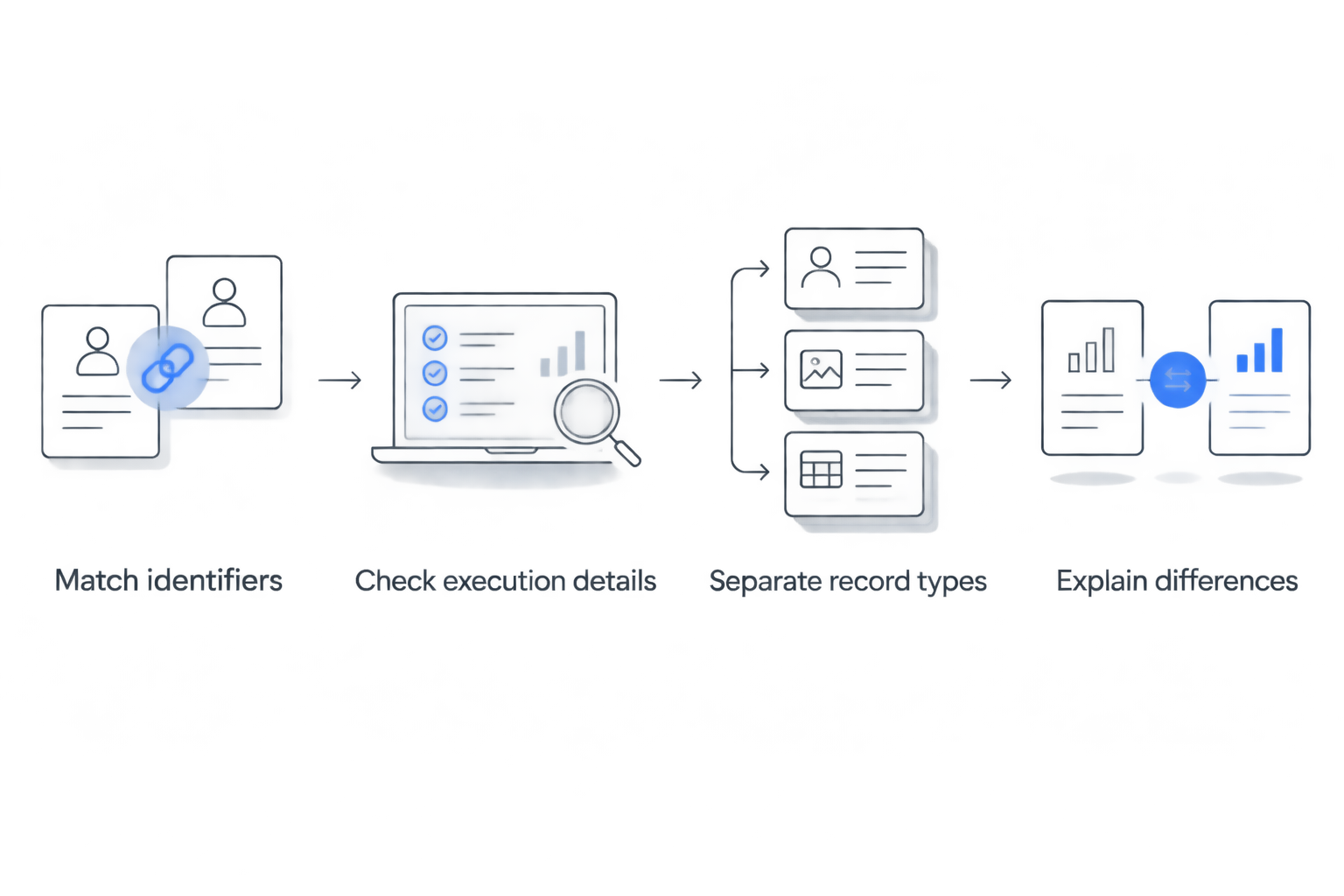
Preserve the original records before interpreting the analysis.
These are reconciliation checks for your records. They are not a claim that VCG ONE accepts a particular statement format or uses every listed field in its scoring calculation.
05
Connection verification
- Follow the confirmed route. Use the connection instructions for your account. Authorise only the access described there. Do not substitute a generic file-import tutorial.
- Check the destination account. Match the account reference wherever the connection process identifies it. Resolve an account mismatch before reviewing performance.
- Verify history coverage. Use the history information exposed by the service or request confirmation through support. Check the account and period against your reconciliation record.
- Record the review point. Note when you checked the analysis and what coverage you verified. Keep unresolved coverage questions beside the score.
Do not assume that a successful sign-in proves historical coverage. Authentication and history inclusion answer different questions. Likewise, a newly visible score does not by itself prove that every older trade has been included.
Avoid repeated uploads or reconnections while investigating a discrepancy. First establish the cause and the supported remedy. Repeating an unverified process does not demonstrate that its input is correct.
Expected result: You have evidence of the connected account and the history covered. If coverage remains unconfirmed, keep that limitation attached to any interpretation.
06
Repeat reviews after new activity
Once the connection and coverage are established, repeat the reconciliation after new trading activity. This is a review routine. It does not require an assumed upload schedule or an undocumented automation.
- Keep the account reference and review boundaries visible in your journal.
- Check which new activity falls within the next review period.
- Compare the scope before comparing the score. Note any change in instruments, position sizes or trading frequency.
- Write one behavioural question to investigate. Keep it separate from a prediction about future returns.
Use a question that the records can answer. For example, compare recorded holding times with your written plan. Do not infer the original intention from the final result.
Expected result: Each review has a traceable evidence base. A score change becomes a prompt for investigation rather than a verdict on your next trade.
07
Troubleshooting history differences
- Trade counts differ. Check whether one record counts orders and another counts executions or closed positions. Reconcile identifiers before removing apparent duplicates.
- A trade falls on another date. Compare the displayed time zones and review boundaries. Keep the original timestamp alongside any converted time.
- The statement total differs from your calculation. Check account currency, commissions, financing entries and adjustments. Compare matching components rather than an execution-only calculation with an account-wide total.
- Older activity is absent. Confirm the supported history period and account source. Do not assume that preparing another file will extend coverage.
- A score change lacks an obvious explanation. Check coverage and sample composition first. Do not reverse-engineer a scoring formula from a few observations.
When escalating a discrepancy, describe the account, affected period and specific record references. State what you expected and what you observed. Remove unrelated personal information from any supporting material.
08
Customize your review
Add decision context in your journal. Record the setup, planned exit conditions and any departure from your written process. Keep these observations distinct from execution facts.
Behavioural scoring provides a structured review lens. Its limitation is equally important: an execution record does not contain every reason behind a decision. Your contemporaneous notes add context without changing the underlying history.
Choose one process question for the next review. Ask whether you followed a documented rule. Avoid treating a higher score as permission to increase exposure or as evidence of future profitability.
Frequently asked questions
How do I feed trade history into my VCG ONE score?
First confirm the supported account source and connection instructions for your account. Follow that route, then verify the history period included before interpreting the score.
Can I upload a spreadsheet of old trades?
Use a spreadsheet upload only if the account instructions explicitly support it. Preparing a spreadsheet does not establish that VCG ONE accepts the file or includes its records in scoring.
Does VCG ONE score every historical trade automatically?
Do not assume complete historical coverage. Confirm the connected account and supported history period before treating the analysis as a review of all past activity.
What should I check before connecting my trading history?
Check the account identifier, review dates, time zone and original activity records. Confirm the supported connection route before granting access or submitting a file.
Why does my trade count differ from my statement?
Check whether the records count orders, executions or closed positions. Partial fills can create several execution records for one order, so match identifiers before deleting apparent duplicates.
Does a higher behavioural score predict profitable trades?
A behavioural score is not a promise of profitable trades. Use the analysis to investigate your process, not as an instruction to enter a position or increase exposure.
Should I combine history from several trading accounts?
Keep account histories separate unless the supported workflow explicitly allows combined analysis. Record the scope so differences between accounts remain visible.
Conclusion
One final check deserves a place in every review: write down the coverage beside the score. A number without its account and period is difficult to compare responsibly. Keep the original statement, the verified scope and your decision notes together.
Verify the history before interpreting the score.
Related guides
- Missing data in a trading review
- Trading patterns and sample size
- Sharing trading data for analysis
- Weekly trading review workflow
This article is for educational purposes only and does not constitute investment advice. Trading CFDs and other leveraged products carries a high level of risk and may not be suitable for all investors.


