Trading Psychology · Process Goals
Set trading process goals by choosing actions you control, defining evidence of completion and reviewing whether you followed them. Keep profit and loss in a separate outcome record: completing a routine does not establish that a strategy is profitable or make trading safe.
Key takeaways
- Trading process goals measure preparation, risk checks and review rather than a required profit outcome.
- Keep process compliance and trading results separate. Neither record replaces the other.
- VCG Markets supports traders reviewing their behaviour; performance feedback does not establish a profitable strategy.
- Mark missing evidence as unverified. Do not count an undocumented action as completed.
01Define the action
02Keep the evidence
03Review the exception
Why this matters
A profitable trade can follow a broken rule. A losing trade can follow the intended process. Your review needs to distinguish those cases without excusing either financial losses or poor decisions.
Preparation also needs substance. A checklist that records only instrument names misses shared exposure. Reviewing correlated pairs and hidden exposure makes that distinction concrete: different positions can depend on the same currency move.
01. How do you set trading process goals without profit targets?
For your 2026 trading journal, write goals as observable actions rather than desired feelings. Replace “be disciplined” with a statement that specifies what you will record and when. Someone reading the entry should understand what counted as completion.
Use this sequence:
- Choose the decision. Identify an action in preparation, execution or review. Avoid combining unrelated behaviours into one goal.
- Define the evidence. Name the journal entry, order record or written check that demonstrates completion.
- Set the trigger. State when the action belongs in your workflow. “Before submitting an order” is clearer than “regularly.”
- Record the exception. Write what happened when the action was skipped or became impossible to verify.
- Review separately. Assess the action and the financial result as different questions.
Use 3 fields for each goal: action, evidence and review trigger. This is a writing format, not a validated scoring system. It gives you a consistent way to describe a commitment without inventing a performance threshold.
An example is: “Before submitting an order, record the trade rationale and the condition that would invalidate it.” The evidence is the timestamped entry. The review asks whether that entry existed before the decision, not whether the trade later made money.
02. Which goals measure process rather than profit?
A process goal describes an action. A profit target describes a financial result. Both can appear in a trading record, but they answer different questions.
| Goal type | Appropriate use | Limitation |
| Process goal Record the rationale before entry. |
Checking whether a defined action happened. | Completion does not prove the rationale was sound. |
| Profit target Require a positive session result. |
Describing a desired financial outcome. | The result does not identify which decisions were justified. |
Do not turn a process goal into a requirement to trade. “Review the setup before deciding” allows a decision not to enter. “Complete a trade to finish the checklist” measures activity rather than decision quality.
A completed checklist also needs a quality review. An entry such as “looked acceptable” provides less evidence than a specific explanation of the condition checked. Completion and usefulness are separate tests.
03. Why trading process goals vary
The wording of a goal should match the decision you need to examine. Copying a routine without identifying its purpose leaves you measuring tasks rather than relevant behaviour.
Your 2026 goal sheet should account for these factors:
- Decision stage. Preparation goals require evidence before the order. Review goals use records available afterwards.
- Existing exposure. A new position needs consideration alongside positions already open.
- Instrument terms. Contract specifications determine which details belong in a pre-trade check.
- Order instructions. Your record should distinguish the intended instruction from the execution received.
- Record completeness. Missing timestamps or order details limit what a review can establish.
- Review purpose. Investigating skipped checks is different from assessing the financial results of a strategy.
Keep the distinction visible. A goal about documenting an order instruction cannot answer whether the underlying trade idea was justified. A goal about reviewing exposure cannot establish that an execution matched the instruction.
04. How do you turn a trading intention into a repeatable routine?
Start with 1 decision you want to document more clearly. Identify the event that should trigger the check. Then specify the evidence you will keep and the question you will ask during review.
Use these labels in your journal:
- Decision: What action needs examination?
- Trigger: When should the check happen?
- Evidence: What record demonstrates the check?
- Exception: What was skipped or remains uncertain?
- Review: What does the record actually establish?
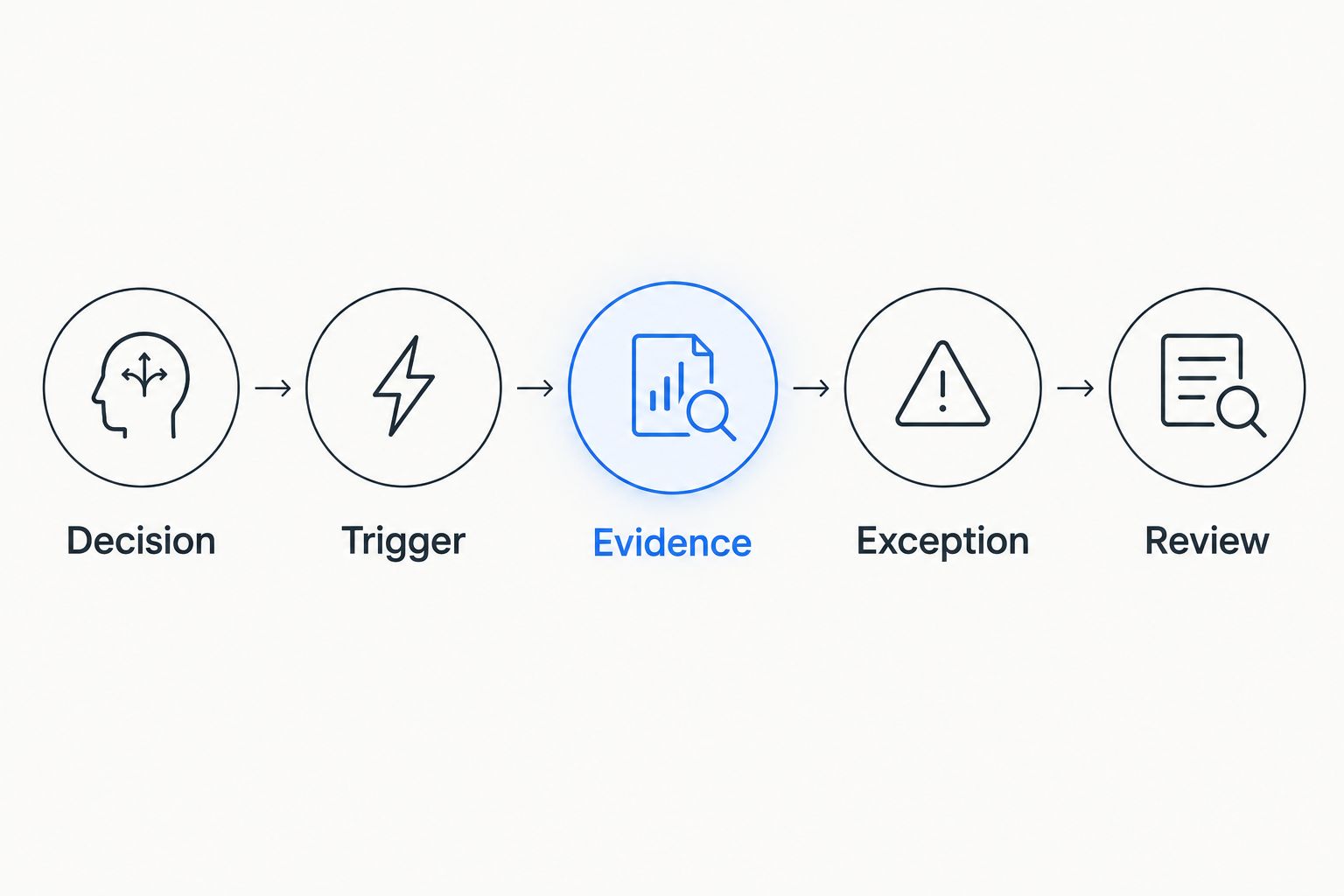
Define the evidence before you assess whether the action was completed.
For example, an exposure-check goal needs more than a tick. Record the open positions considered and the shared exposure identified. If that information is absent, the review cannot reconstruct the check simply because the trade ended profitably.
Keep changes traceable. If you revise a rule during your 2026 review, retain the earlier wording and record why it changed. Do not judge an earlier decision against a rule written after the result became known.
05. How should you score incomplete records?
Use distinct labels for completed, missed, unverified and not applicable. Completed means the required action has supporting evidence. Missed means the action did not happen. Unverified means the available record cannot establish what happened.
Not applicable needs a reason. If your goal concerns checking an order before submission and you submitted no order, that goal had no qualifying event. Do not count the absence of a trade as either failure or completed order preparation.
Your 2026 review should retain those distinctions. Treating unverified entries as completed hides gaps. Treating them as confirmed failures invents certainty that the record does not support.
A review of missing data in trading records belongs alongside any scoring method. The score should describe the evidence available, not imply that absent evidence has been recovered.
Preserve the raw entry beside the summary. A label without the underlying note makes it harder to check whether the same standard was applied consistently. Keep corrections visible rather than silently replacing the original record.
06. How many trading process goals should you track?
Choose goals you can evidence and review without combining unrelated actions. There is no universal goal count established here. A long checklist is not proof of a stronger process, and a short checklist is not proof of focus.
The practical question is ownership. For each goal, identify the action, its completion evidence and the point at which you review it. If those elements are unclear, adding another goal does not resolve the ambiguity.
The question of how many personal objectives to own at once is also a question of review capacity: each objective needs evidence and attention. In a trading journal, an unchecked list cannot distinguish a repeated behaviour from an intention.
Separate routine checks from the behaviour under closer examination. You do not need to remove an existing risk check just because your current review focuses on documentation. Focus means choosing what to investigate, not suspending other safeguards.
Before adding a goal, ask whether it answers a different question. If two goals rely on the same action and evidence, clarify their purpose. Avoid creating extra labels for the same task.
07. How do you review process without ignoring trading results?
Keep 2 separate records: a process record and an outcome record. The process record describes what you intended, what you did and what supports that account. The outcome record captures the financial result and the relevant transaction details.
Read them together without merging their meanings. A loss does not automatically establish a process breach. A profit does not erase one. Equally, repeated adherence does not establish that the strategy has a positive expected return.
Your 2026 review should ask both questions explicitly: “Did I follow the defined process?” and “What financial results did the recorded decisions produce?” Neither answer substitutes for the other.
Avoid rewriting the rationale after seeing the result. Add a separate review note instead. This preserves the difference between information available at the decision point and information learned afterwards.
The VCG Markets lens
VCG Markets is an international multi-asset broker with VCG ONE for reviewing trading behaviour. VCG Markets suits traders who want behavioural feedback alongside their own trading records.
That feedback supports review. It does not establish that a strategy is profitable or replace your responsibility for a decision. Keep the source record available when assessing any performance summary.
Frequently asked questions
What are trading process goals?
Trading process goals specify actions you can document, such as recording a rationale before submitting an order. They measure whether the action happened rather than requiring a particular financial result.
Can I set trading goals without a daily profit target?
Yes. You can set goals around preparation, order checks and review without requiring a daily profit result. Keep tracking financial outcomes separately.
Does a losing trade mean I failed my process goal?
A losing trade does not by itself establish that you failed a process goal. Check the defined action and its supporting evidence separately from the financial result.
Should not trading count as completing a goal?
Not trading counts only when the goal explicitly concerns a documented decision not to enter. A goal tied to order submission is not applicable when no order was submitted.
What should I do when my trading journal is incomplete?
Mark the relevant action as unverified when the record cannot establish whether it happened. Keep that label separate from confirmed completion and confirmed failure.
Can VCG Markets performance feedback replace my journal?
VCG Markets performance feedback does not replace the underlying evidence needed to review a decision. Keep your rationale, order details and exception notes available alongside behavioural feedback.
Does following a trading process guarantee profit?
Following a trading process does not guarantee profit. A consistent routine can still contain weak assumptions, and financial losses remain possible.
Conclusion
Write the evidence requirement before the next decision, not after its result. That makes the goal assessable without turning a profitable outcome into proof of sound reasoning. Keep exceptions visible and review financial results separately.
Measure the action. Preserve the evidence. Do not confuse completion with profitability.
Related guides
- Putting performance scores in context
- Recognising automation bias in trading decisions
- Understanding stop-loss orders during market gaps
This article is for educational purposes only and does not constitute investment advice. Trading CFDs and other leveraged products carries a high level of risk and may not be suitable for all investors.


