Trading Performance · 2026
Compare trading performance by time of day by grouping trades into consistent entry-time windows. Measure net results alongside initial risk, trade count and rule adherence. Keep the instrument and strategy comparable before treating a stronger time window as a repeatable pattern.
Key takeaways
- Compare trading performance by time of day using consistent timestamps and net results, not winning trades alone.
- Separate entry timing from exit timing. They answer different trading journal questions.
- Check risk, strategy and rule adherence before attributing performance differences to the clock.
- VCG ONE scores eight behavioural dimensions. Behavioural feedback does not establish that a time window predicts future returns.
01Prepare the records
02Compare like with like
03Check the explanation
01
How do you compare trading results by time of day?
- Choose the question: entry timing, exit timing or exposure while holding.
- Standardise timestamps and define fixed time windows.
- Group comparable trades by instrument and strategy.
- Compare net results, initial risk and trade counts.
- Review rule adherence and unusual events.
- Check whether the pattern persists in a separate period.
Why this matters
A profitable morning does not prove that morning entries are stronger. Larger positions or a different strategy can explain the result. Your review needs to separate the time label from the decisions behind it.
Use trading process goals to define what you are measuring. For a 2026 review, write the question before inspecting the strongest time window. This keeps the analysis tied to a decision rather than a preferred explanation.
02
Prepare timestamps before comparing results
Keep the original execution timestamp. Add a separate column for the time zone used in your analysis. Record whether the source is platform server time or another reference.
A 2026 export can span a clock change. Check the applicable offset for each date rather than applying the current offset to every record. If your question concerns a market opening, preserve each trade’s relationship to that opening.
For hourly analysis, a window contains 60 minutes. Narrower 30-minute windows provide more detail but leave fewer observations in each group. Wider 2-hour windows combine more trades but can conceal differences within the window. Choose the boundaries before reviewing the results.
- Keep: instrument, strategy, entry time, exit time and position size.
- Add: initial planned risk, net result and rule-adherence notes.
- Flag: missing timestamps, partial closes and changes to the strategy.
- Preserve: the original export alongside the cleaned review file.
Treat multiple fills from the same trading decision consistently. Counting each fill as an independent trade can distort both trade count and win rate. Document the grouping rule so another review uses the same definition.
03
Separate entry timing from exit timing
An entry-time review assigns the completed trade result to the window when the position opened. An exit-time review assigns it to the closing window. Neither shows exactly when profit or loss developed while the position remained open.
| Method | Suitable for | Strength | Limitation |
| Entry timing | Reviewing opening decisions | Connects outcomes to entry windows | Includes everything that happened after entry |
| Exit timing | Reviewing closing decisions | Groups realised results by closing time | Does not identify when the result developed |
| Holding exposure | Reviewing changes during open positions | Tracks movement within each window | Requires reliable position valuations over time |
Use entry timing when the question is whether opening decisions differ by hour. Review exits separately. Combining both questions in the same ranking makes the explanation less clear.
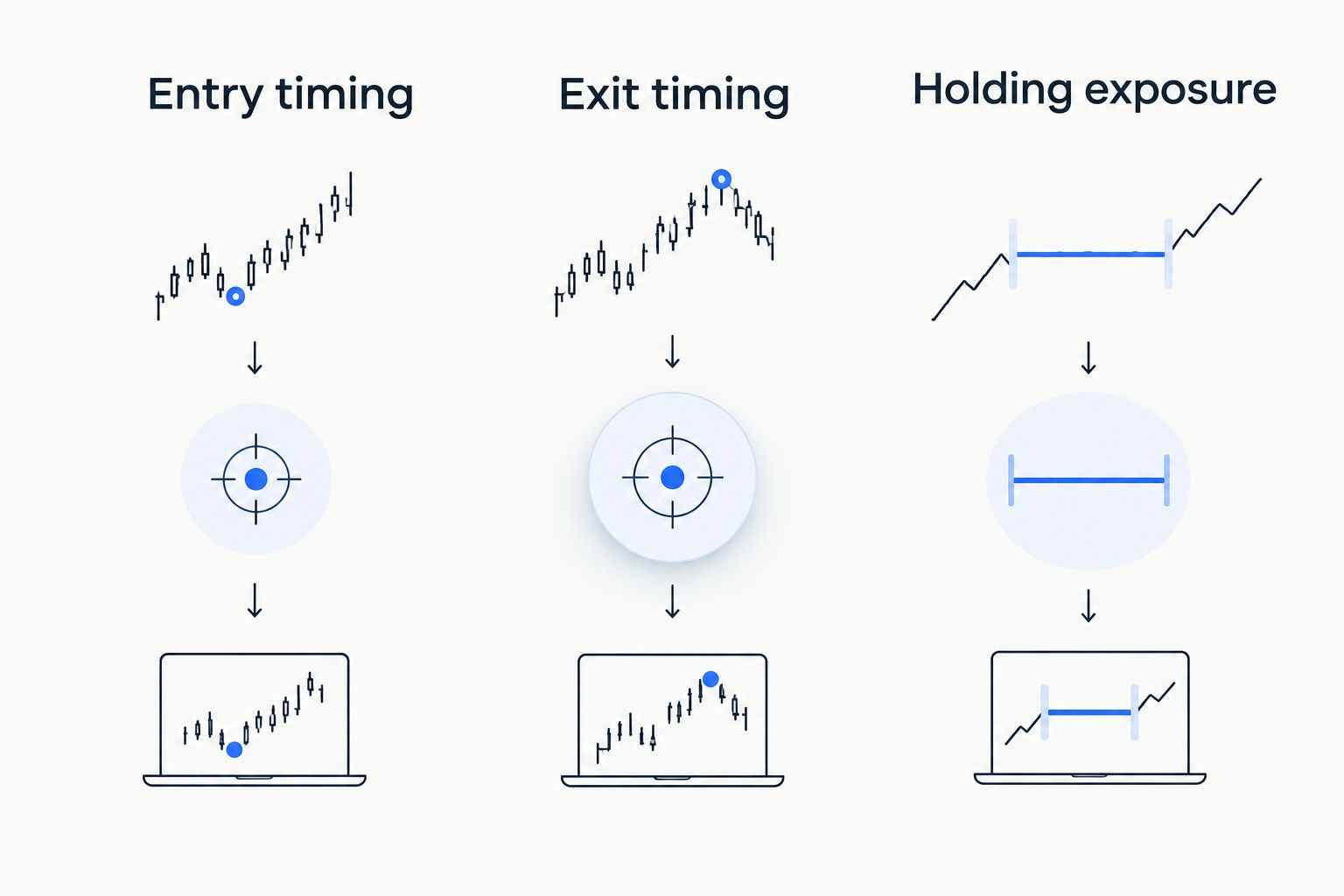
Entry and exit windows answer different questions about the same trade.
04
Compare results alongside risk and trade count
Total net profit answers how much a group contributed. Average net result answers how much each recorded trade contributed on average. Neither adjusts for differences in position size or initial risk.
Where initial planned risk is recorded, divide each trade’s net result by that risk. Compare these risk-relative results alongside account-currency results. Do not reconstruct initial risk from the final stop location after the trade has closed.
- Trade count: shows how much recorded activity supports the comparison.
- Net result: includes applicable trading charges without subtracting them twice.
- Win rate: shows the share of winning trades, not their size.
- Average win and loss: reveal what win rate leaves out.
- Risk-relative result: helps compare trades with different initial risk amounts.
- Rule adherence: separates outcome review from decision review.
Keep the reporting currency consistent. Review currency conversion in trade results when your records involve different currencies. A conversion difference should not become evidence for a timing pattern.
For your 2026 worksheet, show all these measures together. A window with a higher win rate can still have a lower net result. A profitable window can also contain decisions that broke the trading plan.
05
Why trading results vary across time windows
The clock groups trades. It does not isolate the cause of their results. Check these factors before describing a window as stronger or weaker.
- Instrument mix: different instruments can have different trading schedules and market conditions.
- Strategy mix: a window containing different setups is not a clean comparison of timing alone.
- Risk allocation: larger initial risk changes the size of account-currency gains and losses.
- Execution conditions: spreads and slippage affect the recorded outcome.
- Holding duration: an entry window can inherit price movements from much later.
- Decision consistency: departures from your plan change what the group represents.
Add event notes where relevant. Distinguish scheduled announcements from ordinary trading conditions. If the records do not contain the information needed to test an explanation, leave that explanation unconfirmed.
06
How do you check whether a timing pattern holds?
Keep the same boundaries and definitions in a separate review period. Do not change the windows after seeing which arrangement produces the strongest result. That tests a newly selected pattern rather than the original one.
Inspect the largest winning and losing trades. Show how the comparison changes when those observations are considered separately. Keep them in the original record; the purpose is to reveal concentration rather than remove inconvenient outcomes.
Should you stop trading a weaker time window?
A weaker recorded window is a review finding, not an automatic instruction to stop trading. Check strategy, risk and adherence first. The same clock hour can contain very different decisions.
Can you compare different instruments in the same hourly group?
You can aggregate them to describe account activity. Separate the instruments before drawing conclusions about timing. Otherwise, a change in instrument mix can look like a change in hourly performance.
Keep a dated conclusion for each 2026 review. State what the records show, what remains unresolved and which definition the next review will reuse. A reproducible comparison is more useful than a changing leaderboard.
FAQ
How do I compare trading performance by time of day?
Group comparable trades by entry-time window. Compare net results alongside initial risk, trade count and rule adherence. Use consistent timestamps and keep the window boundaries fixed.
Should I use my local time or platform time?
Use a documented time reference consistently. Preserve the original platform timestamp and check date-specific offsets before converting records.
Is win rate enough to identify a stronger trading hour?
Win rate is not enough to identify a stronger trading hour. Compare average wins, average losses and net results alongside the amount initially at risk.
How many trades do I need for an hourly comparison?
There is no universal trade count that makes an hourly comparison reliable. Report the count in each group and inspect concentration, dependence between trades and consistency across separate periods.
Should an overnight trade belong to its entry hour or exit hour?
Assign an overnight trade to its entry hour when reviewing opening decisions. Use its exit hour for a separate review of closing decisions. Neither method isolates when the result developed.
Does VCG Markets behavioural feedback prove that a trading hour works?
VCG Markets behavioural feedback does not prove that a trading hour predicts returns. VCG ONE scores eight behavioural dimensions. An hourly review still requires consistent records and comparable trades.
Conclusion
Before changing your schedule, change the question from which hour made money to which comparable decisions produced the result. For a 2026 review, freeze the definitions and preserve the original records. Then check the pattern again without moving the boundaries.
One final check: look for hours with no trades. An empty window is missing evidence, not evidence of weak performance. Your trading schedule determines which parts of the day your journal can describe.
Compare the decisions behind the hour. Do not treat the hour as the explanation.
Related guides
This article is for educational purposes only and does not constitute investment advice. Trading CFDs and other leveraged products carries a high level of risk and may not be suitable for all investors.


