Indices Trading · Trading Hours
Yes. You can trade indices outside regular stock market hours when your chosen index instrument has an open trading session. The underlying shares do not need to be trading for an index-linked instrument to trade. In 2026, the exact schedule still depends on the contract, its venue and your broker. Extended hours do not mean uninterrupted trading or unchanged execution conditions.
Key takeaways
- Can you trade indices outside market hours? Yes, when the specific index instrument has an open session.
- An index instrument can trade while its constituent shares are closed. Its quoted price can differ from the cash index.
- Check the session, time zone, maintenance breaks and holiday schedule before placing an order.
- VCG Markets traders should confirm instrument specifications rather than infer trading hours from an index name.
01Understand the instrument
02Check the session
03Review execution risks
Why this matters
A stock exchange closing does not necessarily close every instrument linked to its indices. Equally, a moving chart does not prove that you can place an executable order. Your decision depends on the exact symbol and its current trading status.
Start by [reading the contract specifications](https://vcgmarkets.com/en/blog/read-contract-specifications). Separate the underlying stock exchange schedule from the trading hours attached to your position. They answer different questions.
01
Can you trade indices outside regular stock market hours?
Yes, provided the index instrument itself is open for trading. An index measures a basket of shares. You trade a financial instrument linked to that index rather than buying the published index calculation itself.
That distinction explains why trading can continue after the underlying share market closes. Futures markets and broker-provided index instruments have their own sessions. Those sessions need not match the constituent shares’ regular trading hours.
| Reference or instrument | Outside share-market hours | Main distinction |
| Published cash index | Not itself an executable instrument | Measures constituent share prices |
| Index futures | Trade during their exchange-defined session | Have contract-specific expiry and settlement terms |
| Broker-provided index instrument | Trades during the broker’s specified session | Uses the instrument’s pricing and order rules |
Extended access offers more time to respond to market information. It does not remove breaks or execution risk. A 2026 schedule must be checked for the instrument you actually hold.
02
How to check whether your index instrument is open
Check the symbol before checking the clock. Similar index names can refer to contracts with different pricing references and trading sessions. A saved schedule for another symbol is not sufficient.
- Exact symbol. Open the specifications for the position you intend to trade. Confirm whether it is cash-linked or futures-linked. Check for an expiry date where relevant.
- Session hours. Find the dealing session for the relevant day. Distinguish trading permission from a feed that only displays quotes. Confirm whether orders can be opened, reduced or closed.
- Time zone. Identify the time zone used in the schedule. Convert it to your own clock. Do not assume the platform clock uses your device’s settings.
- Trading breaks. Check scheduled pauses and the next reopening. A session extending beyond share-market hours can still contain a daily interruption.
- Holiday notices. Read the applicable 2026 holiday notice. Shortened sessions and special closures take priority over a routine weekly schedule.
Complete these checks before submitting an order. If the schedule and the order ticket disagree, resolve the difference first. Repeated order attempts do not establish whether a market is open.
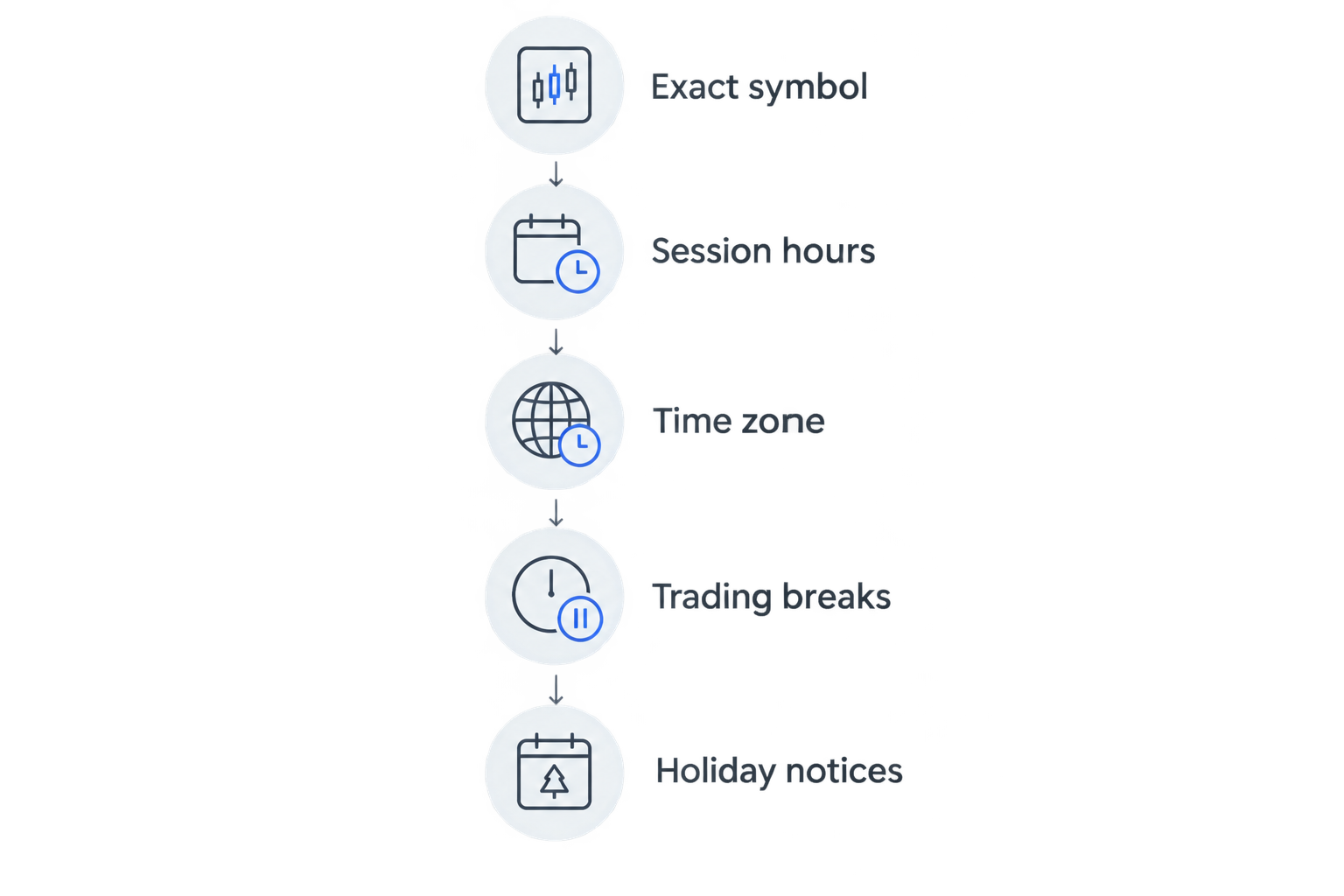
Check the instrument’s dealing session rather than relying on the stock exchange closing time.
Keep the source of the schedule with your trading notes. Record the applicable date and time zone. This makes a later review more useful than a screenshot showing only a local clock.
03
Why index trading hours vary
There is no universal index trading timetable. The schedule belongs to a particular contract and trading arrangement. These factors explain the differences:
- Instrument structure. Cash-linked instruments and dated futures contracts follow their own terms. Sharing an index reference does not make their sessions identical.
- Trading venue. An exchange defines sessions for its listed contracts. A broker defines the dealing hours offered for its own instruments.
- Scheduled maintenance. A trading day can include an interruption. An extended session is not necessarily a continuous session.
- Holiday calendars. A holiday can shorten or close a session. The underlying market and the instrument’s venue do not always follow identical calendars.
- Clock changes. Daylight-saving changes can alter the relationship between a published session and your local time. Recheck the conversion rather than shifting every schedule automatically.
For 2026 trading, use the current contract schedule alongside any dated notices. A search result describing an index’s usual hours is background information. It is not permission to deal in a specific symbol.
04
What changes outside the underlying share session?
Trading access and execution quality are separate questions. An open session tells you that dealing is permitted. It does not guarantee the spread, available liquidity or execution price.
Liquidity and spreads
Participation changes across sessions. When available liquidity is thinner, spreads can widen and orders can encounter less depth. Check the live bid and ask rather than treating the chart’s last price as your entry price.
Extended hours provide flexibility. The trade-off is that conditions outside the underlying share session can differ from the conditions used in your analysis. Evaluate the actual quote before committing to an order.
News and price discovery
Economic releases and company announcements can arrive after constituent shares stop regular trading. An open index-linked instrument can react to that information. Meanwhile, the cash index can still reflect the underlying market’s earlier closing prices.
A difference between those prices is not automatically an error. They can represent different instruments at different moments. Confirm the pricing reference before drawing a conclusion.
Stops and reopening gaps
A stop order does not guarantee execution at its trigger price. A session break or fast-moving market can create a difference between the trigger and the fill. A stop-limit order introduces a different risk: it can remain unfilled.
Read how [market gaps affect stop-loss execution](https://vcgmarkets.com/en/blog/stop-loss-market-gap). Check which price triggers your order and what happens when the instrument reopens beyond that level.
05
What to check before holding through a break
Holding an existing position is not the same as having continuous control over it. During a closed session, you cannot assume you can exit immediately. Order handling follows the contract and platform rules.
- Next dealing session. Identify when the instrument reopens. A pending order is not a completed exit.
- Holding terms. Check whether overnight financing or other adjustments apply. The answer depends on the contract.
- Margin requirements. Understand the requirements for maintaining the position. Do not equate an unchanged account balance with unchanged position risk.
- Expiry and adjustments. Check dated contracts for expiry. Check applicable terms for rollover or dividend-related adjustments.
Do not assume a daily maintenance break marks the financing cutoff. These are separate contract details. The same distinction applies to a cash-market close and the time an adjustment is booked.
Holding terms belong in the original decision. Discovering them after the underlying exchange closes leaves less room to change a plan before the next dealing interruption.
06
Record the session, not just the result
Your 2026 trading review should distinguish entries made during the underlying share session from entries made outside it. Otherwise, different execution conditions sit inside the same results category.
Record the exact symbol and entry time. Include the time zone, observed spread and intended order type. Note whether a scheduled announcement or session reopening was involved.
Separate the trading idea from its execution. A directionally correct view does not explain a poor fill. Equally, a favourable fill does not establish that a particular session suits your process.
Use comparable records when reviewing patterns. Avoid treating an isolated overnight trade as evidence about every extended session. The useful question is whether your documented decisions and execution conditions match what you planned.
FAQ
Can I trade indices after the stock exchange closes?
Yes, when your chosen index instrument has an open dealing session. Check its contract specifications rather than assuming it follows the constituent shares’ regular hours.
Does an index chart moving mean I can place a trade?
No. A chart update does not establish that your account can execute an order in that instrument. Confirm the dealing status and live executable quote.
Can I trade an index during the weekend?
Only if the specific instrument explicitly offers a weekend dealing session. Do not infer weekend trading from an extended weekday schedule.
Are index prices the same after the cash market closes?
Not necessarily. An index-linked instrument can react to new information while the cash index reflects the underlying share market’s earlier prices. Check which reference each quote represents.
Will my stop-loss execute during a trading break?
Do not assume execution during a closed session. Order handling follows the instrument’s rules, and a reopening gap can cause a stop order to fill beyond its trigger price.
Do index trading hours change for holidays?
Yes, holiday schedules can shorten or close an instrument’s session. Check the dated notice alongside the normal weekly timetable.
Is trading outside regular market hours less risky?
No. Trading outside regular share-market hours does not remove market risk. Liquidity, spreads and reopening gaps still affect execution and position management.
Conclusion
You can trade indices outside regular stock market hours through instruments whose sessions remain open. Check the exact symbol, time zone and any scheduled interruption. Then assess the live execution conditions and the terms for holding the position.
One final distinction matters: the cash index closing and your tradable instrument continuing to move are compatible. Before interpreting the difference as a trading signal, establish whether you are comparing the same instrument at the same time.
The underlying exchange’s closing time is not your instrument’s trading schedule.
Related guides
This article is for educational purposes only and does not constitute investment advice. Trading CFDs and other leveraged products carries a high level of risk and may not be suitable for all investors.